
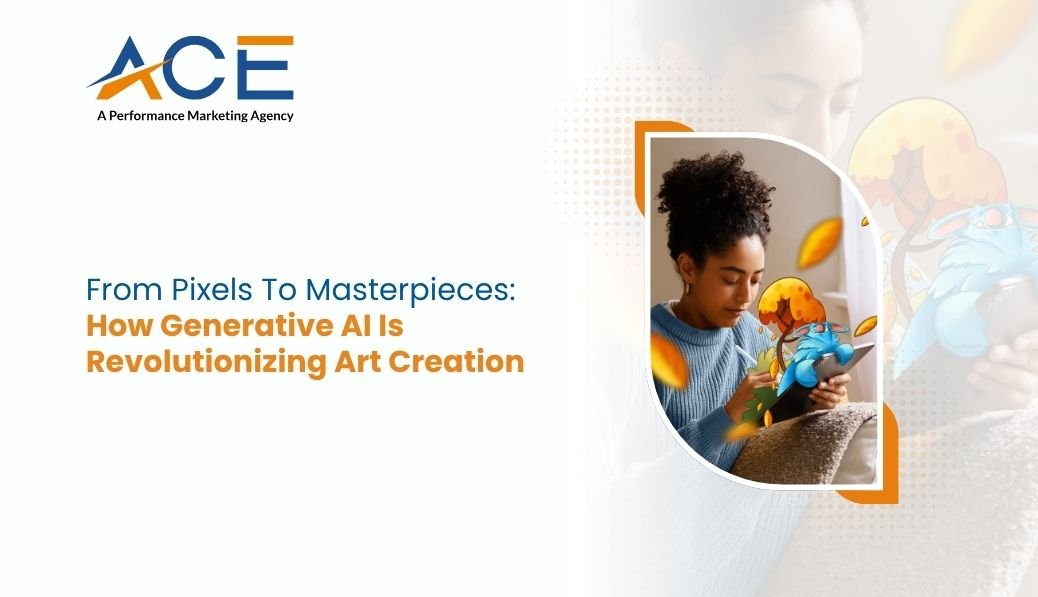
You have probably scrolled past an image on Instagram this week and paused for half a second longer than usual, unsure whether a human or a model produced it. That flicker of uncertainty is where the entire creative industry now sits. Generative AI has moved from a curiosity in research papers to a working layer inside advertising studios, gaming pipelines, and independent artist workflows. It is not replacing creativity so much as changing what creative work looks like, how quickly it happens, and who gets to participate. This piece walks you through how generative AI is reshaping art creation, where it delivers real value, where it raises legitimate concerns, and what any brand or creator should understand before treating it as a serious production tool.
Generative AI refers to models trained on massive datasets of images, sounds, or text that can produce new outputs in response to a prompt. In visual art, the dominant technique uses diffusion models, which start from random noise and progressively refine it into an image that matches the intent described in the prompt. The output is not retrieved from a library. It is generated pixel by pixel based on patterns the model has learned.
That distinction matters. Traditional design software waits for a human to draw every line. Generative systems compose from statistical understanding of style, composition, color, and subject. A prompt like “an oil painting of a rainy Mumbai street at night in the style of impressionist landscapes” produces a unique image each time, shaped by parameters the artist controls: aspect ratio, mood, palette, level of realism, and iteration on earlier drafts.
The scale of this shift is significant. The global AI creativity and art generation market was valued at USD 51.89 billion in 2024 and is projected to reach USD 141.7 billion by 2034, growing at a compound annual growth rate of 26.5%, according to Market.us research. That growth is not driven by hobbyists alone. Advertising and marketing applications already account for roughly 30% of total revenue.
The current generation of tools has consolidated around a handful of models, each with its own strengths. Midjourney remains the reference for stylized, editorial-quality visuals. Adobe Firefly integrates directly into Photoshop and Illustrator, giving working designers a generative layer inside familiar software. DALL-E, Stable Diffusion, and open-source variants offer flexibility for developers building custom pipelines. Runway and Sora have extended the same logic to video, allowing short clips to be generated or edited from a text prompt.
For agencies and in-house teams, the practical effect is a compressed production timeline. What used to require a photo shoot, retouching, and multiple rounds of design review can now start with a working concept in minutes. This is why our creative design services framework increasingly blends generative tools with human art direction, keeping brand consistency intact while cutting the time from brief to first draft. The point is not to hand creative decisions to a model. It is to give creative directors more iterations to choose from before spending real production budget.
Generative AI is not just an aesthetic upgrade. It changes the economics of visual content, and that has direct implications for anyone building a brand. Three shifts are worth naming.
The result is not that everyone becomes a designer overnight. It is that the ceiling of what a small team can produce has moved up sharply, and the floor of acceptable quality has moved up with it.
Adoption follows use cases where the return is clear and measurable. Six categories are seeing the strongest traction:
Roughly 29% of digital artists already use AI in their creative process, according to industry surveys, showing that adoption is no longer confined to experimental studios. It is quietly becoming standard practice.
Any honest conversation about generative art has to address what these models were trained on and who owns what they produce. The current landscape has three unresolved tensions.
The first is training data. Most major image models were trained on billions of images scraped from the public web, some of which were copyrighted. Lawsuits from artists, stock libraries, and publishers are ongoing across multiple jurisdictions, and the outcomes will shape what “clean” generative output looks like in the years ahead.
The second is authorship. When a prompt produces a striking image, who is the author? The prompt writer, the model developer, or neither? Legal systems are still working through this, and copyright protection for purely AI-generated work remains inconsistent globally.
The third is displacement. Freelance illustrators, junior designers, and stock photographers report meaningful pressure on rates and job availability. Even the most optimistic view of the technology has to reckon with the fact that some creative work is being absorbed rather than augmented.
For brands, the practical guidance is straightforward. Use commercially licensed models where possible, keep provenance records for generated assets, avoid mimicking living artists’ distinctive styles without permission, and disclose AI use where audience expectations warrant it. Cutting corners here creates legal exposure and, increasingly, reputational risk.
There is a common assumption that generative AI benefits only large organizations with budgets to build custom pipelines. The evidence points elsewhere. Independent creators are among the earliest and most inventive adopters, using these tools to prototype film scenes, design album art, illustrate self-published books, and build visual identities that would have required a full agency a decade ago.
For solo founders, this changes the economics of showing up online. A boutique clothing brand can generate a season’s worth of on-brand editorial imagery without a photo shoot. A local restaurant can produce region-specific menu visuals that feel considered rather than templated. When paired with the right media strategy from a capable social media advertising company, that creative output can be tested, iterated, and scaled with a level of speed that legacy production models simply cannot match.
The winners in this shift will not be the teams that use AI the most. They will be the teams that use it with the clearest creative direction, the sharpest brand instinct, and the most disciplined quality control.
Generative AI in art refers to artificial intelligence models trained on large datasets that can create new visual, audio, or textual outputs based on prompts. In visual art, tools like Midjourney, DALL-E, Stable Diffusion, and Adobe Firefly generate original images from written descriptions, style references, or existing artwork inputs.
Traditional digital tools like Photoshop or Illustrator require the artist to create every element manually. Generative AI produces original visual output based on patterns learned from training data, allowing the artist to describe intent rather than execute every stroke. The role shifts from execution to direction, curation, and refinement.
There is no single answer. Auction houses, galleries, and collectors are treating select AI-generated works as significant art, with a Christie’s sale of an AI-generated painting reaching USD 432,500. Many working artists view AI as a legitimate creative tool. Others argue that authorship requires human intention throughout the process. The debate is unresolved and will likely shape critical standards for years.
Businesses can use AI-generated images commercially, but with important caveats. Use commercially licensed tools, keep documentation of prompts and generation history, avoid outputs that closely mimic copyrighted works or specific living artists, and stay current on jurisdiction-specific rules around AI content disclosure.
Start with clear brand guidelines, use generative tools for ideation and variation rather than final delivery, keep human review at the quality-control stage, and track performance of AI-assisted creative against manually produced benchmarks. The goal is faster iteration inside a disciplined creative process, not replacing creative judgment entirely.

C – 81C, Sector – 8, Noida 201301, India


1025 Beamon Drive, Franklin 37064 Tennessee, USA
Sveavagen 34 111 34 Stockholm, Sweden

Copyright ©ACE. All rights reserved.

