
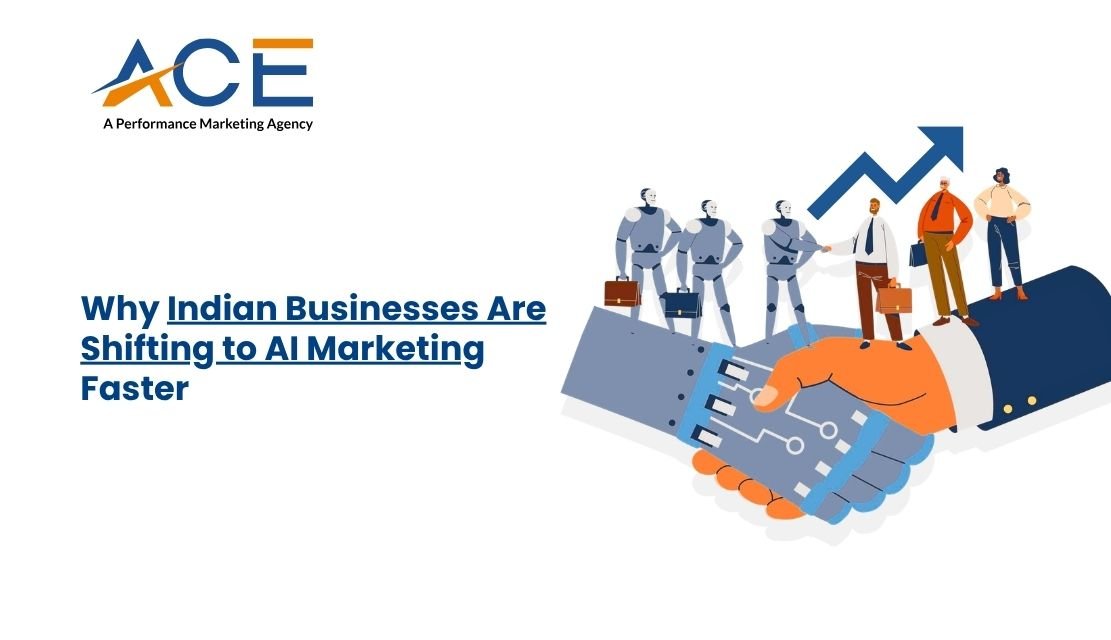
Something is going on across India’s business landscape. Companies here aren’t just adopting AI marketing tools, they’re doing so at a pace that’s outstripping many mature markets. Walk into any mid-sized Indian company these days, and chances are high that you will see marketing teams using AI already – for customer targeting, content generation, or campaign optimization.
This isn’t accidental. A combination of market pressures, infrastructure improvements and competitive dynamics have come to create the conditions in which adoption of AI in the marketing space makes immediate practical sense for Indian businesses. Understanding why this shift is taking place so quickly offers important information for any company still trying to think about its approach.
Indian business is in an extremely competitive environment where margins are very important. Marketing budgets are always under scrutiny and demonstrating return on every rupee spent isn’t optional, it’s expected. AI tools specifically address this pressure in a way that manual approaches simply cannot compare to.
When AI is used to deal with audience segmentation, the AI system will analyze customer data constantly instead of analyzing data periodically. With AI in control of ad bidding, it becomes an optimization that happens in real-time, as opposed to weekly changes. When AI creates content variations, it creates dozens of options in the amount of time it takes a human to create one. Each of these capabilities translates directly to efficiency gains that are compelling to budget conscious Indian businesses.
The cost structures have also changed in favor. Many AI marketing tools now have a pricing model that works for smaller companies and not just enterprise companies with massive budgets. Cloud-based delivery No major infrastructure investments. Pay- as-you-go options minimize the risk. For Indian businesses used to stretching resources, these economics make the adoption straightforward rather than aspirational.
India’s digital world has changed dramatically over the last few years. Hundreds of millions of consumers have affordable smart phones. Data costs have fallen to one of the lowest in the world. Digital payment systems are reliable across the country. This infrastructure forms the basis of AI marketing that it needs.
AI marketing tools require data to work effectively and Indian consumers now create an enormous amount of data. Every search on the internet, social media interaction, e-commerce browse on your device or an app results in signals that can be analyzed by AI systems. The sheer volume of digital activity going on across India is the raw material that AI marketing needs to provide meaningful results.
There has also been a significant improvement in regional language capabilities. AI tools are now capable of Hindi, Tamil, Telugu, Bengali and other Indian languages with growing levels of sophistication. This is of enormous significance in a market where communicating to consumers in their language of choice often makes the difference between campaign success and failure. Businesses no longer have to choose between AI capabilities and linguistic relevance – they can have both.
When one company in an industry adopts AI marketing and begins to see results it is not easy for the competition to miss noticing that. India’s business environment is characterized by intense rivalry in practically every sector and advantages don’t remain secret for long. This creates adoption pressure to accelerate the entire market.
E-commerce companies were early movers, and used AI for product recommendations and personalized marketing at scale. Quick commerce players followed, fine-tuning the time of delivery and targeting the promotion through AI. Financial services companies used AI to acquire customers and to risk-based marketing. The leaders of each sector developed examples that were impossible to ignore for followers.
Content marketing companies have seen this trend throughout their client base – once their competitors start utilizing AI capabilities, the pressure to keep up is a difficult one to shake off. Standing still means falling behind, and Indian businesses know this competitive dynamic very well.
India produces a good number of technology graduates every year and AI skills have become more and more prevalent among them. This talent pool makes adoption of AI marketing more viable than it may be in markets where fewer technical resources are available.
Marketing teams don’t necessarily have to be the AI gurus themselves. They can collaborate with technical individuals who know how to implement and manage AI systems. Agencies and consultants that possess AI capabilities have proliferated. The ecosystem to support the adoption of AI in marketing has grown rapidly.
The training programs have also grown exponentially. Many Indian marketers are actively upskilling themselves and learning to work with AI tools in an effective way even if they don’t have a deep technical background. This willingness to adapt mitigates friction that can slow adoption in other markets where work processes are established and resistant to change.
Indian businesses aren’t leveraging AI marketing for the sake of innovation – they are seeing measurable results that justify their continued investment. A number of applications have been found to be of particular value in the Indian setting.
Customer targeting has become more accurate. AI analyses behavioural patterns to pinpoint high-probability prospects to avoid squandering spend on unlikely-to-convert. For businesses that run on thin margins, this efficiency improvement is important.
Content production on a massive scale has occurred. Creating variations for different segments of audiences, languages and platforms used to require proportionate increases in production resources. AI makes this scaling possible without the cost increases, so personalized content strategies become possible for more businesses.
Campaign optimization occurs all the time. Rather than analyzing results every week and taking steps to adjust, AI systems optimize in real-time. Underperforming ads are automatically reduced in their budgets. Successful approaches receive more investments right away. This responsiveness helps make the campaign overall perform better.
Customer service has also expanded around the clock. AI chatbots respond to routine queries at any hour of the day and help in improving response times and support costs. For e-commerce and service businesses, this availability has a direct effect on customer satisfaction and repeat purchase likelihood.
AI marketing adoption in India isn’t obstacle-free. The quality of data is inconsistent in many businesses. Privacy regulations need to be navigated carefully. Skills gaps exist despite available talents on the whole Integration with existing systems can be complicated.
Yet these challenges have slowed the rate of adoption less than might be expected. Indian businesses have shown that they are pragmatic in how they implement AI – they have begun by focusing on applications where data is already clean, responded proactively to privacy requirements, worked with specialists where internal skills are lacking, and implemented AI in stages rather than trying to do a transformation in one go.
The best performance marketing agencies that operate in India have crafted methodologies specifically to address these challenges, helping their clients overcome the hurdles that may delay adoption. This ecosystem support has sped up what might be a slower transition.
The high speed at which AI is being adopted in marketing across Indian businesses does have strategic implications, which leaders need to consider. Waiting for perfect conditions or perfect certainty means further falling behind competitors who are already building AI capabilities and racking up advantages.
This doesn’t mean delving into adoption without strategy. It means realizing that the window of time for early mover advantage is closing and deliberate, but timely action makes more sense than evaluating indefinitely.
The companies moving fastest aren’t necessarily the biggest and most well-resourced. They’re the ones that saw the shift coming way back, and made a commitment to building capability before it was absolutely necessary. They’re now working with efficiency gains and customer knowledge later adopters will have a hard time catching up to.
Indian businesses are embracing AI marketing more quickly than many of their global rivals given the compelling economics, better digital infrastructure, fierce competitive pressure, access to talent and proven practical results. The combination of tight margins requiring efficiency, digital activity producing usable data, competitor success models, and an ecosystem to support implementation has produced conditions for which AI adoption makes immediate business sense. Companies that are still assessing how they are going to do things face widening gaps as competitors develop capabilities and gain advantages.
India’s confluence of fierce competition, small margins that demand efficiency gains, dramatically better digital infrastructure, large technical talent pool, and affordable pricing of AI tools make their adoption make immediate sense rather than having to wait for lengthy evaluation timelines.
Customer targeting and segmentation, content creation on scale across multiple languages, campaign optimization in real-time, and customer service chatbots powered by AI have been especially useful for Indian businesses that are looking to boost efficiency and customer experiences.
Yes. Cloud-based delivery, pay-as-you-go pricing, and non-technical user-based tools have made AI marketing accessible to more than large enterprises. Smaller businesses tend to realize proportionately larger efficiency gains since they’re starting from more manual processes.
Common challenges include inconsistent data quality, compliance with privacy regulations, skills gaps in existing teams, and complexity in integrating with legacy systems. However, pragmatic approaches and ecosystem support have been instrumental in effectively helping businesses surmount these obstacles.
Results depend on application and starting point, but many businesses see results in weeks from applications such as campaign optimization and customer targeting. More comprehensive implementations can require many months for full impact.

C – 81C, Sector – 8, Noida 201301, India


1025 Beamon Drive, Franklin 37064 Tennessee, USA
Sveavagen 34 111 34 Stockholm, Sweden

Copyright ©ACE. All rights reserved.

