
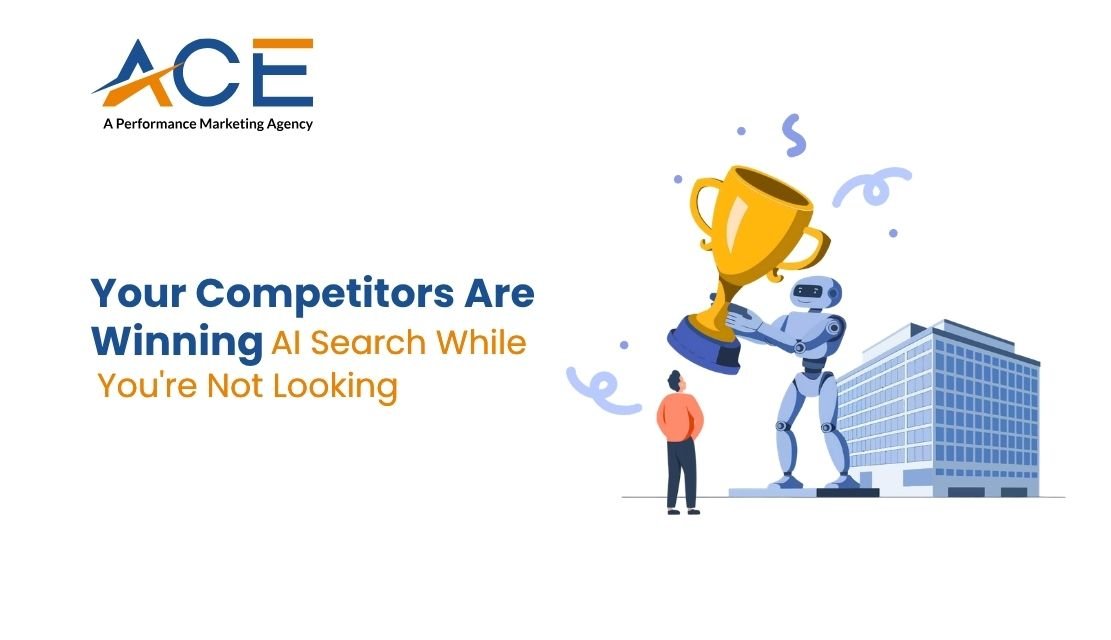
Something significant is taking place in the way people search for businesses and most companies have no idea. Whilst you’ve been focussing on other traditional search rankings, email campaigns and social media, a new battlefield has opened up. AI search platforms like ChatGPT, Google’s AI Mode and Perplexity are becoming more common places where purchase decisions start.
And your competitors have taken notice. Some of them are already trying to optimize for this new reality that you can see in the AI-generated recommendations, and your brand is not visible. The gap is widening daily.
This article explains what’s actually going on with AI search, how the competition is gaining ground, and what you need to do to avoid being left behind with this fundamental shift in the way people are discovering businesses.
Search behavior is evolving more quickly than most marketing teams realize. When someone asks ChatGPT for product recommendations, requests Google’s AI Mode to compare service providers or uses Perplexity to research solutions, they’re getting direct answers instead of lists of websites to visit.
These AI platforms don’t display ten blue links. They recommend specific brands by name, making often synthetic recommendations. If your brand is not in that answer, you are not in the consideration set. The prospect moves on without ever being aware you exist.
This isn’t theoretical. People are increasingly turning to the AI Assists for exactly the types of queries that used to take them to search engines and then to your website. Questions such as “What’s the best CRM for a small marketing agency?” or “What is the best project management tool for remote teams?” now get answered directly by AI systems which may or may not include your brand.
The implications are profound. Traditional SEO was all about getting high enough up in the rankings that people would be inclined to click through to your site. AI search often doesn’t require the click at all. Being mentioned in the response provided by the AI becomes the new goal, and requires different strategies than ranking in traditional results.
While many businesses are still concentrating on traditional marketing channels, forward thinking competitors have begun to optimize for AI visibility. They know that being displayed in AI recommendations generates benefits that compound over time.
They’re developing authority AI systems recognize. AI platforms fetch from what they perceive to be credible and authoritative sources. Competitors investing in true expertise, third-party verification and consistency across trusted publications are becoming the brands AI recommends.
They’re producing content that AI can easily extract. AI systems prefer content that directly answers specific questions in a clear and structured way. Competitors creating detailed comparisons and how-to guides and more structured information are appearing in AI responses with increasing frequency.
They’re getting some citations from sources AI trusts. When AI comes up with an answer, it frequently uses discussions from communities, writings of experts, and third-party reviews. Competitors actively participating in these conversations and being mentioned in these sources are adding to the citation patterns that AI systems use.
They’re monitoring their A.I. visibility. There are now tools specifically designed to track the frequency at which brands are mentioned in A.I.-generated answers. Competitors using these tools know where they are, and can see where possible to improve their position.
Every day you wait for these competitors to solidify their position in AI systems. Their authority compounds. Their visibility grows. The distance between where they are and where you are, grows more difficult to close.
Understanding how AI search differs from traditional search is useful in understanding why your current strategies may not transfer directly.
AI synthesizes instead of lists. Traditional search provides you with options to evaluate. AI search makes an evaluation of the options and offers conclusions. Being the fourth result in traditional search gets you clicks nonetheless. Being absent from AI’s recommendation gets you nothing.
AI is a learning algorithm that learns from different signals. While traditional SEO concentrates a lot on things like on page factors and backlinks, AI systems consider brand mentions throughout the web, conversations in the community, mentions by experts, and content that thoroughly answers questions. The signals that made you rank well in Google may not be the same signals that the AI uses to recommend you.
AI personalizes recommendations. AI systems are increasingly able to customize responses based on user context and preferences. This means different users who ask similar questions might get different brand recommendations. Visibility is no longer single and contained in a ranking position but rather fragmented in segments and in scenarios.
AI recalibrates understanding on a constant basis. In contrast to traditional search indexes that are periodically updated, A.I. systems are continually improving their understanding based on new information. Your competitive position may be changing faster, for better or worse.
Performance marketing companies have begun to take notice of such differences and to tailor their strategies accordingly. Those that haven’t risk watching their effectiveness decrease as user behavior continues shifting towards AI-assisted discovery.
The competitive forces of AI Search reward the early movers in ways that grow ever harder to overcome.
Authority accumulates over time. As AI systems see your brand over and over again, across trusted sources, they start to have stronger associations between your brand and relevant queries. Competitors who build such an authority now will be more difficult to push out later on.
First impressions are lasting impressions. When AI systems learn to recommend certain brands for certain needs, that pattern tends to stay that way. Breaking into sets of considerations already formed by AI requires breaking associations.
The learning curve steepens. Understanding what makes AI systems recommend brands, is relatively new knowledge. Competitors learning now are building expertise as an institutional advantage. Waiting is learning later when the competition field is more full.
Traffic shifts accelerate. And as the number of users embrace Artificial Intelligence search behaviors, the proportion of discovery that occurs through these channels increases. The cost of being invisible is compounded as the channel becomes more important.
Every month you don’t do something is one more month your competitors are building up positions you’ll eventually have to challenge from behind.
While the complete playbook to achieving AI visibility is still being developed, there are certain approaches that continue to enhance how AI systems perceive and recommend brands.
That demonstrates true knowledge of the subject. AI systems know and prefer content that displays in-depth understanding over superficial coverage. Original research, in-depth explanations, and a demonstration of real-world experience are the types of authority AI trusts.
Earn third-party validation. AI borrows much from other people saying things about you. Reviews, mentions in industry publications, presence in community discussions and citations from trusted sources all make a difference to how AI systems view your brand.
Structure content for extraction. When your content clearly answers specific questions, AI can easily spot and use that information in answers. Direct answers, and clear organization and coverage of topics make your content more useful to AI systems.
Build a consistent presence. AI forms impressions about patterns within many sources. Consistent messaging, regular publication and presence on relevant platforms all go into the associations that AI systems make about your brand.
Monitor and adapt. The AI visibility needs constant attention. Tracking how your brand comes up in AI responds, identifying where there are gaps where your competitors are but you are not, and continuously improving your approach are all key.
Performance marketing agencies that collaborate with brands on AI visibility are realizing that these fundamentals, although not complicated, require steady effort and strategic coordination to carry out effectively.
The window of opportunity to develop good AI search visibility is open now but won’t stay that way forever. As more and more brands realize the potential of this and start fighting for AI recommendations, it will become increasingly more difficult to stand out.
Starting doesn’t mean making revolutionary changes to the way you market. It starts with an understanding of where you are today, where competitors are winning, and conscious investments in signals that AI systems use to make recommendations.
The brands that move now will have advantages which will become increasingly difficult for later entrants to overcome. The brands that wait will find themselves playing catch up in a game where first is everything.
Your competitors are already in motion. The question is if you’re going to join them while the opportunity is still accessible or are you going to wait until the gap is insurmountable?
AI search is fundamentally shifting the way people are finding businesses and the businesses that recognize this shift are building visibility while others are still focused on traditional channels. AI platforms recommend brands directly instead of listing websites, so to be considered at all, it’s critical to be present in AI response. The signals that power AI recommendations are different from those that used to be important for traditional SEO, including the need for new strategies based on authority, third-party validation, and content structure. Early movers have compounding advantages that become harder and harder to beat, so acting now is far more valuable than acting later.
AI search visibility – it’s how often and how prominently your brand appears in answers produced by AI platforms such as ChatGPT, Google’s AI Mode, Perplexity and Claude when users ask questions relevant to your business.
Traditional SEO is about getting your site in lists of search results so users click-through to your website. AI search often returns direct answers, mentioning brands by name, and so being present in the AI response is often the goal, instead of just ranking high enough to get clicks.
Ask AI platforms questions that your potential customers would ask about your category. Note which brands are mentioned and recommended. Specialized GEO tracking tools can also track brand visibility across AI platforms over time and compare your performance to your competitors.
AI systems prefer brands who are authoritative, have citations from third-party sources they trust, have a consistent presence on relevant platforms, and produce content that directly addresses particular questions, with clarity and authority.
Yes, but the difficulty grows with time (as the authority of the competitors compound). Starting now while the field is still developing offers a better opportunity than waiting until recommendations from AI become more entrenched.

C – 81C, Sector – 8, Noida 201301, India


1025 Beamon Drive, Franklin 37064 Tennessee, USA
Sveavagen 34 111 34 Stockholm, Sweden

Copyright ©ACE. All rights reserved.

