
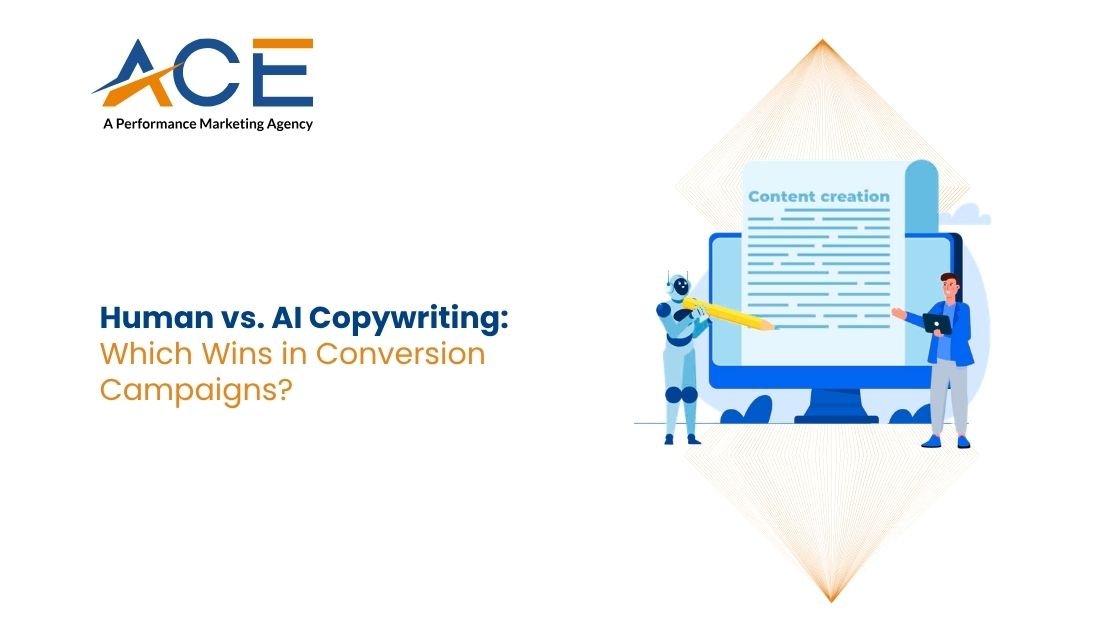
The question itself could well be wrong. Asking whether human or AI copywriting “wins” presupposes that these approaches are competitors when even they might become partners. But knowing where each is stronger is important because conversion campaigns have certain requirements and getting the wrong approach for the wrong context costs money.
AI writing tools have become much more than a novelty. They produce serviceable copy within seconds, try out variations on a scale and never miss a deadline because of writer’s block. Meanwhile, human writers bring intuition, emotional depth and strategic thinking that algorithms can’t replicate. Neither is better or worse across the board. The answer depends upon what you are trying to accomplish, how much you need to produce, and what your audience actually responds to.
Let’s break down what each approach is good at, what each is not good at, and how smart marketers are combining them to improve conversion performance.
AI comes with benefits that are incredibly relevant for high volume, fast moving conversion campaigns.
Speed and scale are transformative. What takes a human writer hours or days, AI does in minutes. Need at least fifty headline variations for testing? Done before you finish drinking your coffee. Undertaking a campaign in multiple segments with customized messaging? AI produces personalised versions without the timeline expansion that would be necessary for human writing.
This speed means direct translation in better optimization. More variations equals more testing. The more testing the faster learning about what actually converts. Campaigns that would have run before with three headlines to test can now be run with twenty, finding winning combinations slower processes would miss completely.
Consistency at volume resolves an actual problem. Human writers naturally differ in the quality of output depending on fatigue, mood and workload. By the fiftieth description of a product, energy fades away. AI treats all products to the same standards whether you are producing the first or the five hundredth piece – useful especially for e-commerce brands handling large catalogs.
Pattern recognition in large data sets helps AI to determine what works. It is able to analyze thousands of top-performing ads, emails, and landing pages to get elements that drive conversions. Human writers are guided by experience and intuition; AI adds to this the data-driven pattern matching that spotting opportunities humans miss.
Cost efficiency at scale means some approaches make economic sense. Testing dozens of variations, creating personalized content for multiple segments or keeping hundreds of product descriptions up-to-date – these become possible when AI is responsible for the volume of content while humans take the reins.
Humans still hold decisive advantages in areas that algorithms won’t be able to touch.
Emotional resonance is the driver behind converting customers for complicated or high-stakes purchases. AI can mimic emotional language, but it doesn’t know the reason why certain stories create connection or how specific audiences experience certain problems. The human writers draw on the power of empathy, lived experience, and cultural intuition that makes copy feel real and not forced.
Trust studies consistently show audiences perceive human-written content to be more credible and emotionally real. For brands that are establishing long-term relationships and not transactional clicks, this difference in perception is important.
Strategic thinking does not just shape the copy piece by piece. Human writers know the context of business, competitive positioning, and audience needs that are unspoken, and that tell them not only what to say, but how to frame the entire conversation. AI generates what you ask for; humans assist with determining what you should be asking for.
Brand voice authenticity requires the understanding of more than just pattern replication. AI can imitate a style of a brand after being trained on samples, but people invent and develop that voice. The finely differentiated differences between “professional but warm” and “professional but friendly”the nuances that make a brand distinctive–are still human territory.
Cultural sensitivity and context helps to avoid costly mistakes. References that are well received by one audience fall flat or offend another. Timing around current events, awareness of cultural moments and juggling of sensitive topics require judgment AI doesn’t have. A human writer knows when a particular phrase may backfire; AI doesn’t know what a backfire is.
Complex persuasion for high consideration decisions, human craft benefits. When someone is thinking about whether or not to commit significant money or make an important change, the copy needs to address objections, build trust progressively and guide through a nuanced decision process. This layered persuasion is still a human strong point.
Performance comparisons show a complex picture instead of a clear winner.
Short-form content such as ad snippets, email subject lines, and social captions often see AI do as well, if not better, than human-written content. The constrained format plays to the strengths of AI in terms of being able to write in a concise and keyword-aware way. When the purpose is attention-grabbing shortness, a good job is done by AI.
Long form persuasive content is another story. Blog posts, landing pages for complex products, and narrative-based campaigns are found to do better with human writers. The depth, storytelling and sustained engagement requires capabilities AI hasn’t mastered.
Trusted content and brand perception is consistently in favor of human-written content in perception studies. Audiences score human copy much better on authenticity and credibility – aspects that are more important for some conversions than others.
The one consistent finding: hybrid approaches are superior to both pure AI and pure human copywriting. Human edited AI content harnesses the speed and scale benefits, with the quality control and feeling that elevates performance.
Rather than pitting the power of AI against that of human copywriting, the best conversion campaigns use a little of both strategically.
AI for volume and variation. Come up with several options for headlines, subject lines, CTAs and ad copy variations. Let AI generate the raw material for testing This opens up more possibilities of finding winning combinations without proportional increases in time or cost.
Humans for strategy and refinement. Human writers provide direction, define the approach and perfect AI output. They catch tone problems, improve emotional resonance, make sure there is a match between a brand, and add that strategic layer that turns serviceable copy into persuasive copy.
AI for optimized data-driven. Use AI to analyze what’s working in your campaigns and make recommendations based on performance patterns. Let it find what opportunities there are in the data that help to make human decisions with strategic impact.
Humans for high-stakes content. Reserve human writing for content where the stakes are highest – important landing pages, brand storytelling, crisis communications, anything that requires cultural sensitivity or complex persuasion.
The practical workflow often looks something like this: AI would generate initial drafts and variations, humans would do the editing for quality and voice, AI would help with optimization based on performance data and humans would make strategic decisions about direction.
Consider the following factors when determining how you want to balance AI and human copywriting:
Volume requirements drive towards AI. In case you need hundreds of variations or personalized content in many segments, AI makes this feasible.
Brand sensitivity drives towards human oversight. The more the importance of your brand voice, the more human editing you need.
Audience sophistication has an impact on the balance. Technical or discerning audiences often better respond to content which has human depth; high volume, transactional situations may not require this.
Testing capacity is what determines whether variation advantage is important for AI. If you can’t actually test lots of variations, then it doesn’t help to produce them.
Stakes of the conversion and complexity of the conversion affect the importance of human craft. Quick, low-cost conversions may not need as much human refinement as high consideration purchases.
Neither AI nor human copywriting is a winner in conversion campaigns all of the time- it depends on what you’re optimizing for and the context. AI is extremely good at speed, scale, consistency and pattern based optimization. Humans are great at emotional resonance, strategic thinking, brand authenticity and complex persuasion. The best approach is for both, using AI to provide volume and variation and humans to provide strategy, refinement and quality control. This hybrid model captures the benefits of both and reduces the respective weaknesses of both.
Neither is universally better. AI is really good for short form content, high volume output, generating test variations in a short amount of time. Human copy writing works better for long form persuasion, brand sensitive copy, and for copy that’s emotionally complex. The best results are usually obtained through the strategic combination of both approaches.
Use AI when you need high volume, fast, want to create lots of variations to test, are consistent across a large set of content, or need to personalize messaging across multiple audience segments. AI works especially well for ad copy variation, email subject lines and product descriptions at scale.
AI has trouble with genuine emotional resonance, cultural sensitivity or strategic thinking and complex brand voice. It can imitate patterns but doesn’t grasp context the way humans do. For high-stakes content where trust and authenticity is an issue, AI output usually needs human refinement.
Typically, AI is used to create first drafts and variations, humans make edits for qualities, voice, and emotional resonance, AI helps with optimization based on performance data, and humans make strategic decisions. This captures the speed and scale of AI and adds human quality control.
Studies show audiences believe human-written content to be more trustworthy and genuine. But when the output of AI is properly refined by humans, this difference tends to go away. The key is the use of AI as a tool but with human oversight for quality and brand alignment.

C – 81C, Sector – 8, Noida 201301, India


1025 Beamon Drive, Franklin 37064 Tennessee, USA
Sveavagen 34 111 34 Stockholm, Sweden

Copyright ©ACE. All rights reserved.

